Laparoscopic Hernia Surgery
Overview
A hernia occurs when an internal part of the body pushes through a weakness in the muscle or surrounding tissue wall. Hernias are commonly found in the abdomen, but can also appear in the upper thigh, belly button, and groin areas.
Laparoscopic hernia surgery is a minimally invasive procedure used to repair hernias, which are protrusions of an organ or tissue through a weak spot in the surrounding muscle or connective tissue. This technique is commonly applied to various types of hernias, including inguinal, umbilical, and incisional hernias.
Inguinal hernia repairs are one of the most common general surgical operations performed in the world. Diagnosis of inguinal hernias is typical performed using a thorough history, and physical and is typically signified by a bulge in the groin. There are many treatment options for patients with inguinal hernias including watchful waiting, open primary repair, open tension-free repairs with the use of mesh prosthetics, and laparoscopic repairs which are typically performed with mesh prosthetics.
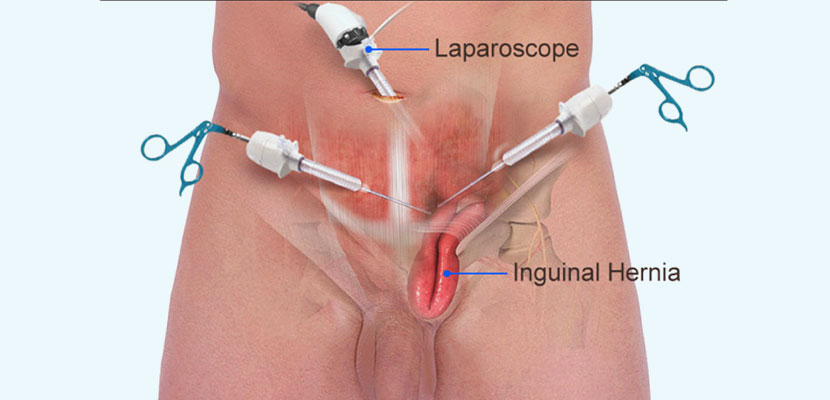
Types of Hernias
1. Inguinal Hernia
- Location: Groin area.
- Description: Intestines or bladder protrude through the abdominal wall or into the inguinal canal.
- Common in: Men.
2. Femoral Hernia
- Location: Upper thigh/outer groin.
- Description: Similar to inguinal hernia but occurs lower, near the thigh.
- Common in: Women.
3. Umbilical Hernia
- Location: Near the belly button.
- Description: Part of the intestine protrudes through the abdominal wall near the navel.
- Common in: Newborns, pregnant women, obese individuals.
4. Hiatal Hernia
- Location: Upper stomach.
- Description: Part of the stomach pushes through the diaphragm into the chest cavity.
- Common in: People over 50.
5. Incisional Hernia
- Location: Site of a previous surgical incision.
- Description: Intestines push through the abdominal wall at the site of a past surgical operation.
- Common in: People over 50.
Risk Factors
- Parenteral nutrition
- Middle-aged female
- Rapid weight loss
- Obesity
- Pregnancy
- Diseases of the ileum
- Medications such as ceftriaxone, and estrogen
Symptoms
Hernia may cause no signs or symptoms. If a hernia lodges in a duct and causes a blockage, the resulting signs and symptoms may include:
- Sudden and rapidly intensifying pain in the upper right portion of your abdomen
- Back pain between your shoulder blades
- Pain in your right shoulder
- Vomiting
- Stone may reach the bile duct resulting in fever, and jaundice
- Stones may pass down, resulting in pancreatic duct blockage and causes pancreatitis
Looking For Best Laproscopic Hernia Surgeon in Jaipur?
Book Your Appointment with Dr. S.K. Saini
Best Gastrointestinal Surgeon in Jaipur, serving for more than 14 years as proctologist and bariatric surgeon in Jaipur.
Contact UsTreatment
- Medical therapy is not the most effective approach. Surgery is the most suitable treatment.
- Immediate surgical intervention is indicated for symptomatic gall bladder stones
- Asymptomatic stone should be followed up regularly. Gall bladder stones (3 cm) require operation.
- ERCP is indicated for stones passed in CBD
When to Consult Doctor Suresh Kumar Saini
Seek immediate care if you develop signs and symptoms of a serious gallstone complication, such as:
- Abdominal pain so intense that you can't sit still or find a comfortable position
- Yellowing of your skin and the whites of your eyes (jaundice)
- High fever with chills
 Reviews